Abstract:
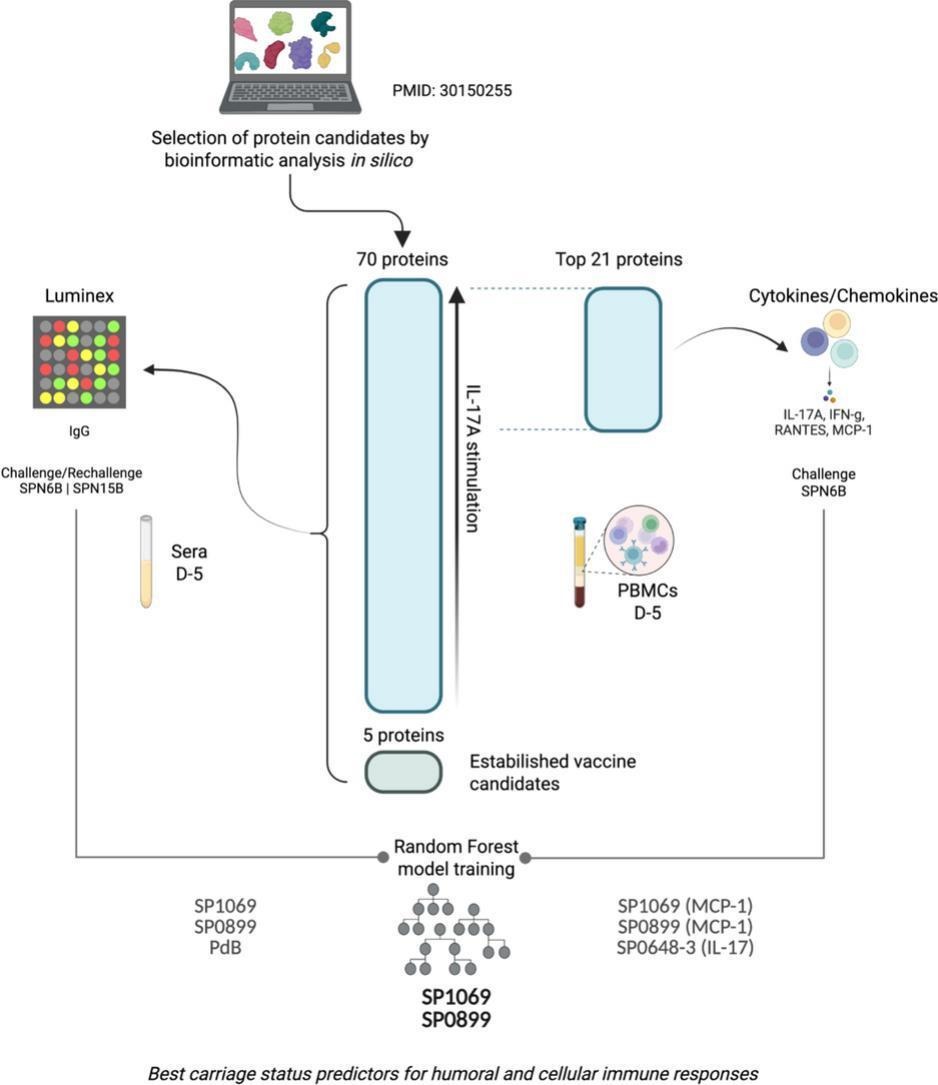
Identifying conserved, immunogenic proteins that confer protection against Streptococcus pneumoniae (pneumococcus) colonization could enable development of serotype-independent vaccines. our controlled human infection model, no individual IgG or cytokine/chemokine response correlated significantly with protection against colonization with pneumococcus, suggesting that effective immunity reflects a coordinated, multi-antigen response. To capture these complex patterns, we trained independent Random Forest models on humoral and cellular datasets. The humoral model identified IgG responses to PdB, SP1069, and SP0899 as predictive of protection. The cellular model revealed that MCP-1 responses to SP1069 and SP0899, and IL-17A production in response to SP0648-3, were associated with protection. Elevated baseline IFN-γ, RANTES, and anti-protein IgG levels were linked to reduced colonization density. highlight SP1069 and SP0899 as potential serotype-independent vaccine candidates and demonstrate the utility of machine learning to identify immune correlates of protection.Tuberculosis (TB) remains a global public health challenge, with the current BCG vaccine providing limited efficacy in adults, and available treatments being lengthy and debilitating. To overcome these challenges, we have previously developed a recombinant BCG strain expressing the detoxified E. coli Heat-Labile Toxin (LTAK63), providing increased protection in mouse models and reduced lung pathology. Here, using systems biology and RNA sequencing of lung tissues in a murine model, we uncover the molecular mechanisms underlying rBCG-LTAK63’s increased protection. Immunization triggered early activation of cAMP-related pathways, leading to hypoxia, autophagy, and circadian rhythm gene regulation. These processes were associated with an enhanced innate immunity and promoted long-lasting Th1/Th17 adaptive responses. Upon challenge, mice immunized with rBCG-LTAK63 exhibited an earlier onset of interferon-gamma response, reduced bacterial burden, and improved lung histopathology. Notably, circadian rhythm regulation was directly linked to a controlled inflammatory response and reduced migration of infection-susceptible cells, resulting in decreased immunopathology. Our findings demonstrate that rBCG-LTAK63 orchestrates protection through the integration of metabolic and temporal immune pathways. This work provides mechanistic insights into how rational vaccine design can reprogram host immunity to enhance protection and reduce pathology, supporting rBCG-LTAK63 as a promising next-generation TB vaccine candidate.
Figure: