Abstract:
Background: The 13-valent pneumococcal conjugate vaccine (PCV13) has been shown to be directly protective against serotype 3 disease. Nevertheless, this serotype continues to be a frequent cause of pneumococcal disease in the UK and also remains prevalent in nasopharyngeal (NP) carriage. Current epidemiology could be explained by the lack of effects of PCV13 on NP-carriage but could also be consequence of the emergence of serotype 3 clades that are more successful colonizers. We tested these hypotheses by comparing PCV13 protection against Spn3 colonisation for two prevalent clades to placebo-vaccinated individuals and individuals vaccinated with PPV23, which is thought not to protect against carriage.
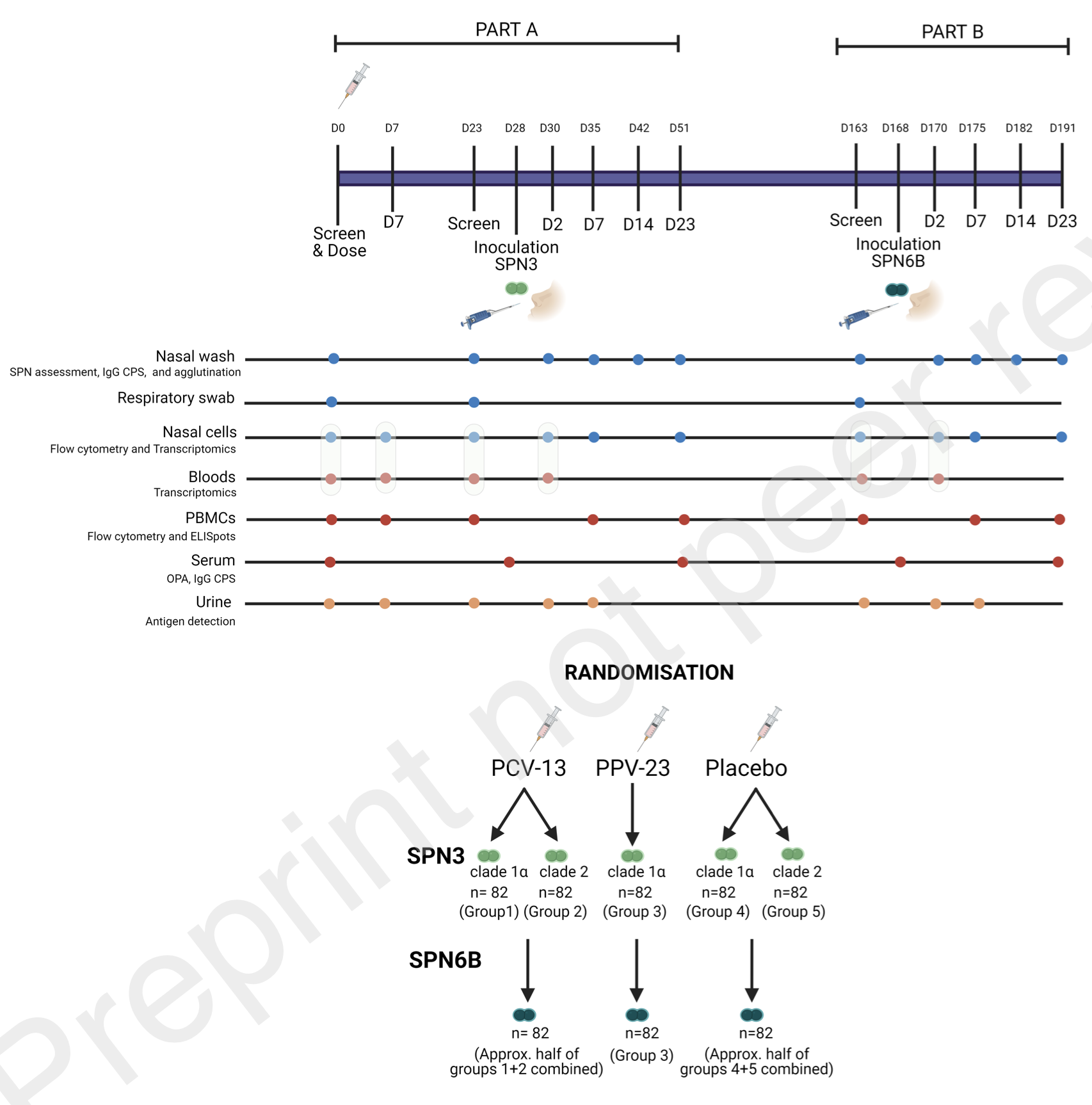
Methods: This trial was conducted between July 2021 and October 2023. Healthy participants aged 18-50 years were recruited in a double-blind, randomised, controlled trial in Liverpool, UK, and assigned (2:1:2) to PCV13, PPV23, or placebo (0.9%NaCl). Participants assigned to the PPV23 arm were challenged with clade Iα while participants in PCV13 and placebo arms were subsequently randomised to receive clade Iα or clade II SPN3. Vaccinators were not blinded. Nasal challenge with Spn3 was at 1-month and Spn6B at 6-months post-vaccination. The primary objective was to compare the acquisition risk of the challenge strain as detected by nasal wash (NW) culture at 2, 7 or 23 days in the vaccine vs. placebo arms. The completed study was prospectively registered (EudraCT:2019-004742-15; ISRCTN15728847; ClinicalTrials.gov:NCT04974294).
Findings: The analysis included 407 and 243 participants challenged with Spn3 and Spn6B, respectively. At 1-month post-vaccination, PCV13 was associated with a non-significant reduction (16%) in Spn3 colonisation acquisition (both clades combined: PCV13 84/153[56%] vs placebo 101/155[65%], RR 0.84[0.7-1.01], p=0.068). PCV13 was moderately protective (29%) against clade II (RR 0.71[0.54-0.91], p=0.009), but not protective against clade Iα (RR 1.01[0.77-1.32], p=0.946), and was not associated with a reduction in colonisation density overall or by clade. For Spn6B 6-months post-vaccination, PCV13 vaccine efficacy was 60% (PCV13 13/81[16%] vs placebo 31/78[40%], RR 0.4[0.22, 0.69], p=0.002) with a 13.8 absolute reduction in AUC colonisation density compared with the control group (p=0.06). No protection was seen with PPV23. There were no severe adverse events.
Interpretation: Our findings indicate limited direct protection by PCV13 against Spn3 colonisation acquisition, with differential protection against the clades and no protection by PPV23 against clade Iα. PCV13 effectiveness persisted against Spn6B colonisation for at least six months with a substantial reduction in colonisation density.
Figure: